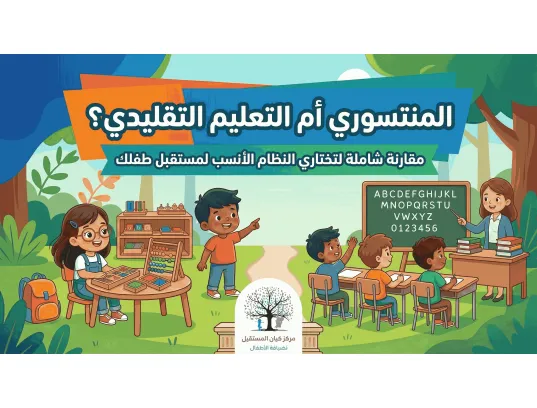
When it’s time to choose a nursery, you will find yourself surrounded by terms like "Montessori," "Traditional System," and "Bilingual." The real question that matters to you is: "Which one will build my child's personality and make them excel?" Is it the system that relies on memorization and total silence (Traditional)? Or the system that provides tools and lets them discover (Montessori)?
The truth is, both systems aim for learning, but their philosophies differ completely. At Future Kayan, we have leaned toward the Montessori method out of a scientific conviction that it is the "language of the brain" for ages 0–6.
First: Traditional Education (The Familiar Model)
This is the system where the teacher is the primary axis. The teacher explains, instructs, and dictates the pace of the lesson.
- The Goal: Transferring information from the book to the child's memory.
-
The Pace: All children in the class learn the same letter at the same time, regardless of their individual absorption speed.
Second: The Montessori Method (The "Follow the Child" Revolution)
Founded by Dr. Maria Montessori, its philosophy states: "The child is the teacher."
-
The Goal: Building a confident, independent human being, not just a storehouse for information.
-
The Pace: Every child is a unique case; they progress according to their personal interest and speed.
Core Comparison Table: Montessori vs. Traditional
| Point of Comparison | Traditional Education | Montessori (At Future Kayan) |
| Teacher's Role | The sole source of info and control. | A guide and observer (intervenes only when needed). |
| Classroom Environment | Fixed chairs facing the whiteboard. | Open environment allowing the child to choose their spot. |
| Teaching Method | Abstract (instruction, photos, paper). | Sensory (hands-on tools the child touches). |
| Handling Mistakes | Teacher corrects in red (signaling failure). | The tool is self-correcting; the child discovers errors alone. |
| Motivation | External (stars, grades, fear of punishment). | Internal (passion for discovery and joy of achievement). |
| Social Skills | Talking is forbidden without permission. | Encouraging cooperation and peer-to-peer learning. |
Why Does Montessori Excel at "Future Kayan"?
Modern studies confirm that a child's brain before age six is an "absorbent sponge." Here is why Montessori is the smartest choice for this stage:
1. Respecting Individual Differences (Your child is not a copy)
In the traditional system, a quick-witted child gets bored, and a child who needs time feels frustrated. At Kayan, your child progresses at their own pace. If they love numbers today, they can spend two hours in the math corner without interruption.
2. Concrete Before Abstract
A child doesn't understand the concept of "1000" if we just write it on the board. But they understand its weight and size when they carry the "Golden Thousand Cube" in our classroom. This builds an indelible foundation in math and language.
3. Our Motto: "Help Me to Do It Myself"
Do you struggle with your child’s total dependence on you? At Kayan, we designed everything to be child-sized (shelves, sinks, chairs) to foster self-reliance, producing a confident child who doesn't wait for someone else to do the work.
4. Self-Discipline (Silence born from passion)
In the traditional system, a child is quiet out of fear. In Montessori, a child is quiet because they are "deeply engaged" in an activity they love. We build an inner conscience, not blind obedience.
Montessori Myths: Let’s Set the Record Straight!
-
Myth #1: "Montessori means chaos and just playing."
-
Truth: The opposite is true! Montessori classrooms are highly organized and quiet. The child has freedom, but it is "Disciplined Freedom"—respecting others and returning tools to their place.
-
-
Myth #2: "Montessori doesn't prepare kids for international schools."
-
Truth: Montessori graduates are in high demand because they possess problem-solving and critical thinking skills that children of rote memorization lack.
-
How We Apply This at "Future Kayan"?
We don't use "Montessori" as a marketing slogan; we apply it as a way of life:
-
Equipped Environment: Original imported tools covering the five corners (Practical Life, Sensory, Language, Math, Culture).
-
Qualified Teachers: Extensively trained in the art of "guiding" rather than "commanding."
-
Smart Integration: We combine the character-building strength of Montessori with the academic power of global curricula (like Phonics and Nooraniyah).
Final Advice for Mothers: How to Choose?
-
Choose Traditional Education if you prefer strict structure and want a child who follows orders literally.
-
Choose Montessori if you want a creative, independent child with a lifelong passion for learning who isn't afraid to make mistakes.
Education is not "one size fits all," but your child's early years deserve an environment that embraces their curiosity rather than killing it.
Would you like to see this educational magic in person?
We are delighted to invite you for a guided tour of our center to witness our children working with quiet passion. The scene will speak louder than a thousand words! Would you like to schedule an appointment for next week?
-(1)-resized.webp)
_optimized_optimized_optimized-(1)_optimized_optimized_optimized-(1)_11zon-resized.webp)